
Your boiler’s flow temperature
Turn it down to 60 and save 8%, everyone says. That advice is written for one type of boiler — and following it on the wrong one causes a different problem entirely.
There’s a piece of advice that’s done the rounds for a few years now. Turn your boiler down to 60 and save around 8% on your gas. It’s genuinely good advice — it costs nothing and takes about a minute, and most boilers are set higher than they need to be straight out of the box.
What almost none of them mention is that it’s advice for one type of boiler. So before you touch anything, go and look in your airing cupboard. A tall insulated tank in there — usually white, sometimes copper, roughly the size of a water butt — means you have a hot water cylinder, and from that point on the advice below changes for you in a way that matters rather more than the saving does.
Flow temperature is how hot your boiler heats the water going out to your radiators — not how warm your rooms get. Most combis are set around 70–80°C by default, and dropping the heating flow to 60°C typically saves about 8% of annual gas use, because the boiler finally starts condensing properly. If you have a hot water cylinder this doesn’t apply the same way — that same flow temperature heats your stored water, which needs to reach 60°C to stay safe. Don’t take a cylinder system below 65°C without an engineer looking at it first.
Which dial am I actually looking for?
Most boilers have two controls on the front and they’re easy to mix up. One is marked with a tap or shower symbol — that’s the hot water, the temperature at the tap. The other usually carries a radiator symbol, and that’s the one this is about: the heating flow temperature, or how hot the water is when the boiler sends it round your radiators.
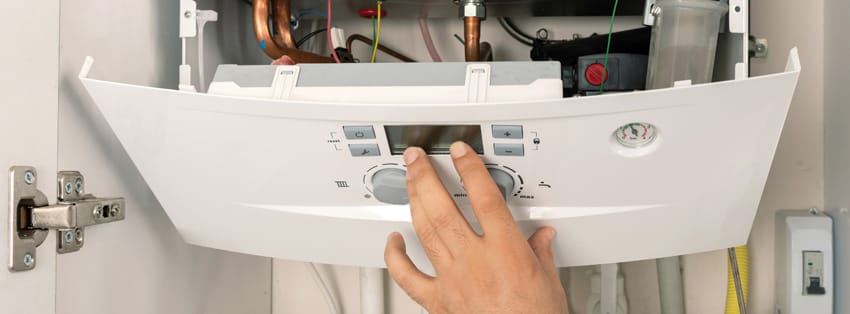
Neither of them is your room thermostat. That’s the thing on the hall wall, and it does a different job entirely — it decides when the boiler fires, based on how warm the room already is. The flow temperature decides how hot the water is once it does.
Turning the flow temperature down does not set your house to 60 degrees. Your rooms still end up wherever the thermostat is set — the radiators just run cooler for longer to get them there.
That distinction catches out more people than anything else here, and it’s why some readers turn it down, convince themselves the house will be freezing, and turn it straight back up a week later.
Why does running cooler use less gas?
Slightly counterintuitive, this one. You’d assume hotter water means the room heats faster, so the boiler runs for less time and it all evens out. It doesn’t — and the reason is sitting in the word “condensing” on the front of nearly every boiler fitted in the last twenty years.
water out to the radiators water coming back 55°C condensing threshold
Return temperatures are typical rather than fixed — how far the water cools depends on your radiators, your pipework and how cold the house is.
Burning gas produces water vapour, and that vapour carries a surprising amount of heat with it. A condensing boiler has a second heat exchanger built specifically to pull that heat back out before the gases go up the flue. But it only does anything if the water coming back from your radiators is cool enough to condense them. For natural gas that threshold sits around 55°C. Above it, the vapour goes straight out of the flue with its heat still in it, and your condensing boiler isn’t really condensing at all.
Run the flow at 80°C and the water returning is usually still too warm for any of that to happen. Run it at 60°C and the return typically drops under the threshold, the boiler starts recovering that latent heat, and the same warmth in your rooms costs less gas to produce. Research by Nesta puts it at roughly 8% of annual gas use for a typical household making that one change, with the boiler’s own efficiency improving by around 4%.
Eight per cent is hard to picture in the abstract. If you want it in real money rather than a percentage, dig out your annual gas statement, find the yearly total and take eight per cent off it. That’s roughly the size of what’s on the table, and it’s a far more honest figure for your house than any national average.
It’s the rare bit of energy advice that costs nothing and can be undone in seconds.
There’s a quirk that falls out of this. You’ll occasionally see a boiler advertised as more than 100% efficient, which sounds like marketing nonsense. It isn’t — it’s a measuring convention. Gas carries two different energy ratings, and the one traditionally used for boiler efficiency leaves out the heat locked up in that water vapour, which for natural gas is about 11% of the total. Recover part of it and you can score over 100% against a yardstick that never counted it in the first place. That 11% is the entire prize condensing is chasing, and flow temperature is what decides how much of it you actually collect.
What should I set it to?
| Heating flow | Hot water | The thing to watch | |
|---|---|---|---|
| Combi | 60°C, lower in mild weather | 50–55°C | Slower warm-up in a hard frost |
| System (cylinder) | 65–70°C | Cylinder thermostat at 60°C | Going lower risks the stored water |
| Regular (cylinder + loft tank) | 65–70°C | Cylinder thermostat at 60°C | As above |
What if my dial isn’t marked in degrees?
Plenty aren’t, and it tends to catch people out at the last moment. Some are numbered 1 to 6. Some use a row of dashes that get longer. Some just show a thin line thickening towards a flame symbol. None of that tells you what temperature you’re actually asking for.
Two things help. The midpoint of the dial is usually somewhere near 60°C, so working blind, halfway is a better starting point than most factory settings. And the manual for your exact model will give you the real mapping — you don’t need the paper copy, because the model number is on a sticker behind the front flap and searching it will turn the manual up in a minute.
Digital displays are easier. Most will show the actual flow temperature in degrees while the heating is running, so you can watch the number move as you adjust it.
One reassurance, because it’s the thing that stops people trying: this is a user setting, no different from the timer or the room thermostat. You can’t damage the boiler with it, you aren’t voiding anything, and if you don’t get on with the result you can put it back where it was in seconds.
But I’ve got a hot water cylinder — does this still apply?
This is the point where the national advice stops being universal, and it matters more than the saving does.
On a combi the flow temperature only ever does one job: heating your radiators. Hot water is made instantly, on demand, and it’s controlled separately. Turn the heating side down and nothing else in the house is affected.
On a system or regular boiler, that same flow temperature also heats the water sitting in your cylinder — and stored hot water carries a requirement that instantaneous hot water doesn’t. Water standing in a tank somewhere between roughly 20°C and 45°C is where legionella bacteria are most comfortable. HSE guidance is that stored hot water should be held at 60°C or above, and because heat is lost on the way into the cylinder, the boiler generally needs a flow temperature of around 70°C to get it there reliably.
So the advice inverts. On a cylinder system, dropping the flow to 60°C doesn’t just cost you a bit of comfort — it can leave stored water sitting below a temperature it needs to reach. We’d say don’t take one below 65°C without having someone look at it properly, and if you’re not certain what you’ve got, the differences between the three types are worth five minutes first.
That’s the position if your boiler runs one flow temperature for both jobs. Plenty don’t. Many modern system boilers hold separate setpoints for heating and for hot water, and that changes the picture entirely — the cylinder gets its 70°C when it calls for it, and the radiators run at 60 the rest of the time. If yours does that, the constraint above largely goes away.
Weather compensation goes further still. With hot water priority, the boiler reheats the cylinder hot and then drops back to a low compensated flow for the heating, and a reheat of ten or fifteen minutes barely registers in the rooms. Worth finding out which of these your boiler can actually do before you settle for a single cautious number. It’s often more than people assume, and it tends to live in the installer section of the manual rather than the pages you were handed.
What about the water coming out of the taps?
Different dial, different logic.
On a combi, water is heated as it passes through, so there’s no standing tankful for anything to grow in. Legionella isn’t the question it is with a cylinder — it’s a stored water problem, and a combi stores none. The tap temperature can sit lower as a result, and 50–55°C is the sensible range: hot enough to be genuinely useful at the sink, without being dangerous.
And it is a safety point rather than a comfort one. Water at 60°C can cause a serious scald in about a second, which is quicker than a child or an older adult will get their hand out of the way. Plenty of combis leave the factory set well above that.
With a cylinder, leave the stored temperature where it belongs at 60°C. The right answer there is a thermostatic mixing valve, blending it down to something safe at the outlet without touching what’s in the tank. Building Regulations already take this seriously — Part G caps a new bath fill at 48°C for precisely this reason.
Will the house take longer to warm up?
Yes, and anyone skipping past that is selling you something.
Cooler water in a radiator means less heat coming off it. Radiator outputs are quoted at a standard difference between the water and the room — ΔT50, which assumes water hotter than most systems now run. At a 60°C flow you’re working nearer ΔT35, and a panel rated at 2,000 watts delivers closer to 1,200 watts. So a room takes longer to come up. Through a normal British autumn that’s rarely noticed, because the heating comes on earlier and runs longer at a gentler intensity — which happens to be exactly the pattern a condensing boiler is happiest with.
Deep winter is where it can bite. If your radiators were sized for 80°C flow, and most older ones were, a hard frost may be more than they can keep up with at 60. The answer isn’t to abandon the idea. Set the heating to come on earlier rather than hotter, and nudge the flow temperature up during a genuine cold snap, then back down when it passes.
What doesn’t work is turning the flow down and then cranking the room thermostat up because the house feels slow. That’s the failure mode we’d flag hardest. The thermostat isn’t compensating for anything — you’ll heat the house past where you wanted it and lose the saving you just made.
How will I know it’s working?
Give it a week before you judge it, and ideally not a freakishly cold one.
What you’re looking for is undramatic: the house still reaching the temperature you set, the heating running in longer stretches rather than short bursts, and radiators that feel properly warm rather than too hot to keep your hand on. That last one unsettles people. A radiator fed at 60°C feels noticeably cooler than one at 80, and it’s easy to read that as the system falling short when it’s doing precisely what you asked of it.
The number that actually matters is on your gas meter, not your radiators, and it needs a full billing period to tell you anything honest.
If after a week the house genuinely isn’t getting there — not “feels different”, but actually failing to reach the thermostat setting on an ordinary day — put it up a few degrees and come down again in smaller steps. There’s no prize for landing on 60 exactly.
And if a full billing period passes and genuinely nothing has moved, the dial may not be the problem. What decides whether a boiler condenses is the temperature of the water coming *back*, and that depends on the system as much as the setting. A system out of balance — the pump pushing hard, the nearest radiators taking most of the flow, the far ones never quite satisfied — hands water back still too warm to condense, whatever the dial says. Balancing is a proper job rather than a dial twiddle, and it’s often the thing that makes the rest of this work at all.
What’s that plastic pipe, and why does it freeze?
Worth knowing before you run the boiler cooler, because you’ll be making more of what comes out of it.
When a condensing boiler does its job, the water it pulls back out of the flue gases has to go somewhere. It drains off through a plastic pipe, usually 22mm, often running out through an external wall to a drain. And it’s plastic for a reason — the condensate is mildly acidic, somewhere around pH 3 to 5, roughly the same as black coffee. Copper wouldn’t last.
The catch is that a pipe running outside carrying a slow trickle of water is a pipe that can freeze. It’s one of the most common reasons a boiler stops in a cold snap, and it tends to announce itself with a gurgling noise and a lockout code rather than anything dramatic.
It’s also one of the few boiler faults you can reasonably sort out yourself. A cloth soaked in warm — not boiling — water, held along the exposed run of pipe, will usually clear it, and then the boiler needs resetting. If it happens twice, the pipe wants lagging or rerouting properly rather than thawing every January.
The honest footnote to all of the above: a boiler condensing properly produces more condensate than one that isn’t. Running cooler is still the right call, but if your condensate pipe has a long outdoor run, insulating it before winter is the job that goes with it.
Does Essex water change the calculation?
It does, and for once in your favour.
This corner of Essex sits in one of the hardest water areas in the country, and temperature is one of the main things driving how quickly scale forms. Calcium carbonate comes out of solution far more readily once water goes past about 60°C. It’s why kettles fur up here, and it’s why a combi’s plate heat exchanger — the component producing your hot water on demand — scales faster in Colchester than the same boiler would in a soft water area.
Running the hot water at 50–55°C rather than 65 won’t stop scale forming. But it slows it down, and on a combi that’s the difference between a heat exchanger that keeps performing and one that starts handing you lukewarm showers a few years in. A small change that quietly protects an expensive part — worth pairing with proper scale protection rather than leaned on by itself.
Whether yours is scaling faster than it should isn’t something you can tell from the outside, which is one of the things an annual service is actually for.
Is a new boiler already set up for this?
Increasingly it should be. Since June 2023, Part L of the Building Regulations has required new and fully replaced wet central heating systems to be sized for a maximum flow temperature of 55°C wherever the property allows it. Partly that’s efficiency, and partly it’s future-proofing — a system designed to work at low temperatures is a system a heat pump could run on later without tearing every radiator off the wall.
Practically, it means radiator sizing matters more than it used to. Turning the flow temperature down on an existing system is free but capped by the radiators already there. On a new installation they can be specified to suit from the start, and that’s where the efficiency actually gets locked in rather than approximated.
It’s worth asking whoever quotes you what flow temperature they’ve sized the system for. A vague answer tells you something.
There’s a second rule worth knowing about, and it’s been in force far longer. Since April 2018, Boiler Plus has required every new combi installed in England to come with one of four things: weather compensation, load compensation, flue gas heat recovery, or smart controls offering both automation and optimisation. Weather compensation is the interesting one here, because it’s essentially the automated version of what this whole article asks you to do by hand — an outside sensor, and a boiler that lowers its own flow temperature as the weather softens. If your boiler went in after 2018 and nobody ever told you which of the four you got, that’s worth asking.
And if none of this is quite the question you had — if the radiators are uneven, or the hot water’s never been right — it’s worth an actual look rather than a setting change.
Common questions
Will turning the flow temperature down make my house colder?
No. The room thermostat still controls how warm your rooms get. The radiators run cooler and for longer to reach the same temperature.
How do I know whether my boiler is actually condensing?
The giveaway is a plume of visible water vapour from the flue in cold weather. People often report that as a fault; it’s the opposite — it’s the boiler working as designed.
Can I do this on a boiler with a digital display instead of dials?
Usually, though it may be buried in a menu rather than sitting on a knob. The manual will call it flow temperature, CH temperature, or central heating setpoint.
Does it save anything in summer?
Not on the heating side, with the heating off. But the hot water dial works all year, and in a hard water area that’s the one doing the quiet work — every degree lower means slower scaling inside the heat exchanger.
My radiators never get properly hot as it is — should I still do this?
If they were struggling before you changed anything, flow temperature probably isn’t the problem. That’s worth having looked at rather than adjusted around.
Most of this you can do yourself in an afternoon, and you probably should — it costs nothing and it’s your gas bill.
The parts that aren’t a dial are the ones worth handing over. Whether your system is balanced well enough for a lower flow temperature to actually pay isn’t something you can tell by looking, and nor is whether your boiler can hold separate setpoints for heating and hot water. Then there’s the condensate pipe, which nobody gives a thought to until the January it gives up.
Rather have someone look at it properly?
All of that gets checked as a matter of course on an annual service — and a service plan is simply that happening every year without anyone having to remember to book it.
Or if you’d just like to know what you’re actually looking at on your own boiler, ring us. We’d rather talk someone through their dial for five minutes than have them leave it sat on 80 all winter, job or no job.
Most boilers are still set the way they left the factory. Yours doesn’t have to be.
Prefer to talk to a real person?
You'll speak to the engineer who'd actually do the job — not a call centre script. Ask us anything, or get a free quote.
Keep reading
More from the blog
 Home Heating Advice
 Spring Is the Best Time to Sort Your Heating
Spring is when your boiler's had its hardest six months and the least pressure to sort it. What a service actually checks, and why.
Read more Home Heating Advice
 How Engineers Read the Signs Your Heating System Shows in Winter
Noise, slow warm-up, pressure changes — what your heating system is telling you when winter puts it under real pressure.
Read more Home Heating Advice
 Heating Myths That Cost You Money
Seven heating myths that quietly cost you money — and what actually works instead, from engineers who see it every day.
Read more