Most people have a vague sense that their boiler should be serviced every year. What they’re less clear on is what that actually means — what an engineer is doing for that hour, and what they’re checking.
That’s a reasonable gap. Boilers sit in a cupboard doing their job, and unless something goes wrong, there’s not much reason to think about them. But it’s worth knowing what happens during a service, because once you do, the case for staying on top of it becomes fairly obvious.
What a service actually involves
When one of our engineers arrives for an annual service, they’re working through a specific set of checks — not a general look around.
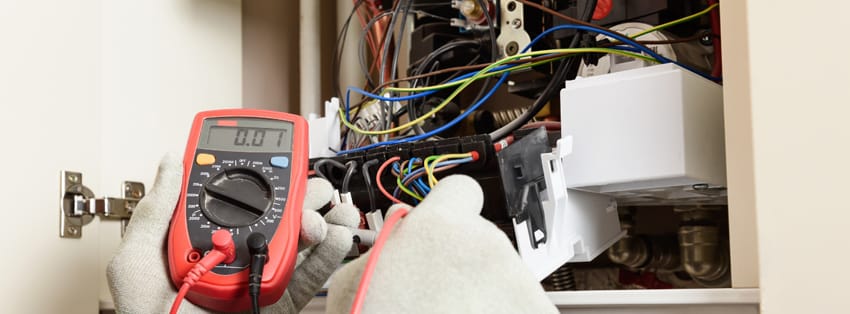
The combustion test is one of the most important. This is a flue gas analysis: a probe goes into the flue to read the combustion gases and check CO levels. A boiler running with poor combustion is wasting money on every gas bill and potentially producing carbon monoxide in amounts that warrant attention. Most homeowners have never been told this happens.
We check the gas valve function and pressure — both standing (at rest) and working (under load) — and test for gas tightness throughout. The expansion vessel gets recharged if needed. The expansion vessel is a small pressurised chamber inside the boiler that absorbs the pressure changes as your heating water heats and cools. When it fails, pressure builds and the boiler starts venting repeatedly through the pressure relief valve. That valve wears out, starts dripping, and what was a straightforward recharge becomes a valve replacement — plus whatever water damage has accumulated in the cupboard underneath.
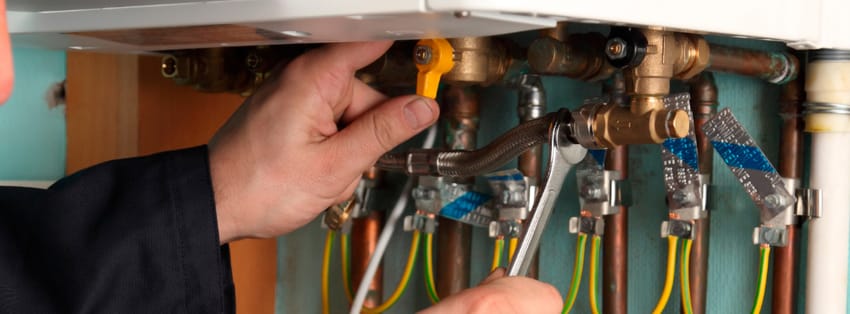
The condensate trap gets cleaned. This is the small plastic container that holds acidic condensate from the boiler’s heat exchanger. In winter it can freeze and cause the boiler to lock out entirely. A blocked one can do the same. Either way, you’ve got no heating and no hot water — and if it’s November, you’re booking an emergency call-out at premium rates when every engineer in Essex is already at full stretch. A two-minute clean during the annual service means it doesn’t become that.
The magnetic filter is cleaned, and the inhibitor in your system is tested and topped up. The inhibitor is a chemical treatment in the heating water that prevents corrosion inside your radiators and pipework. Over time it breaks down and needs refreshing. The filter catches the black iron oxide sludge — magnetite — that circulates when corrosion is happening. Left unmanaged, that sludge settles in the lower part of your radiators and circulates through the pump. It wears the pump out. It coats the heat exchanger. Both are expensive to fix, and the kind of damage that meaningfully shortens a boiler’s working life — sometimes to the point where a power flush or early replacement becomes the only option.
We also check ventilation, flue flow, thermostat batteries, and bleed the radiators if needed. The gas meter gets checked for electrical bonding too — the pipework needs to be earthed to prevent static build-up near a live flame. It’s one of those checks that sounds minor until it isn’t. There’s a visual check of the hot water cylinder and valves. You get a service certificate when we’re done — proof of annual maintenance that home insurers can ask for, and that you’ll want on record if you ever make a warranty claim or sell the property.
That’s the annual service. It’s more involved than most people realise.
Most boiler manufacturers — Worcester Bosch, Vaillant, Ideal, Baxi — require annual servicing as a condition of their warranty. The specific terms vary, but the principle is consistent: skip a year and the warranty may be void when you need it. It’s the kind of thing that only surfaces at the wrong moment, when something has failed and the manufacturer asks for proof of maintenance. That’s what the certificate is for.
A plan, or just booking it yourself?
The obvious alternative to a plan is putting a reminder in your calendar and booking the service yourself each year. Plenty of people intend to do exactly that.
The honest reason most don’t is that a boiler that’s working fine doesn’t create urgency. A reminder in September is easy to push to October. October gets busy. Spring comes and the heating’s been off for months so it still doesn’t feel pressing. Two years pass without a service, and the next time the boiler crosses your mind is when something has stopped working.
That’s not a failing — it’s just how non-urgent tasks compete with everything else. With a plan, the prompt comes from us. When it does, you pick a time that works for you — we’re not throwing a date at you and expecting you to rearrange around it. You fit the appointment into your schedule, we come out, it gets done.
But the stronger case for a plan is continuity.
When you book ad-hoc with whoever’s available, each engineer starts from zero. They can assess what’s in front of them right now. What they can’t see is whether the system pressure is lower than it was twelve months ago, whether the inhibitor has depleted faster than it should, or whether a component that was borderline last year has since got worse. That context only exists if the same engineer was here before.
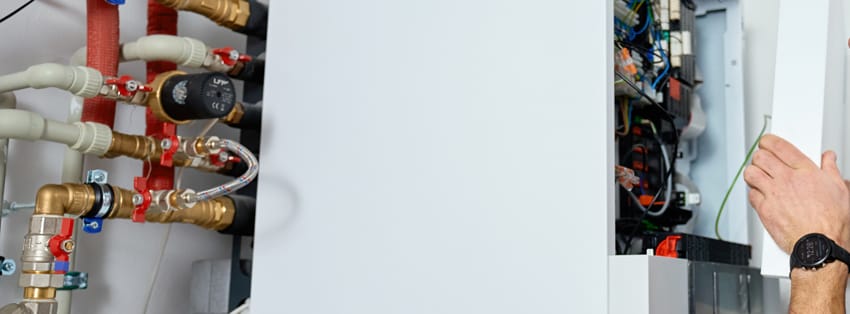
With a plan, we come back. We know what your system looked like last time. If something has changed — and with a heating system something is always gradually changing — we notice it as change, not just as current state. That’s a meaningfully different kind of service.
The 10% discount on any additional work is worth factoring in too. If a part needs replacing or there’s anything remedial needed, the saving on a single job can cover several months of plan cost.
Which plan suits you
Our Basic plan covers the full annual service as described above. For most straightforward gas boiler setups, it’s the right starting point.
Advanced adds a fifth-year strip-down service — a deeper inspection that most manufacturers recommend around that milestone. Gaskets and electrodes are replaced if needed. If your boiler is approaching or past five years old and you want that level of maintenance built in automatically, Advanced is worth considering.
Ultimate adds a full unvented cylinder service and safety check of the cylinder valves. An unvented cylinder is a sealed, pressurised hot water tank fed directly from the mains — if you’re not sure whether you have one, the quickest way to check is to look in your loft. A traditional vented system has a cold water storage tank up there, usually a square plastic tank. If there’s no tank in the loft, your hot water is likely stored in an unvented cylinder. You can also look at the cylinder itself — unvented cylinders have a small discharge pipe running from a valve on the side, usually out to a drain or through an outside wall. Because they’re under mains pressure, they need their own annual safety checks on top of the boiler service. Ultimate covers both.
We also offer a plan for oil boilers, with servicing tailored to oil systems rather than gas — different components, different failure points, same principle.
Why now is a sensible time
Summer is genuinely the easiest time to sort this — not because anything is about to go wrong, but because nothing is. You’re not booking in a rush. We’re not stretched. The work gets done properly, and your boiler is looked after before it needs to be, not after.
If you’ve been meaning to get a plan in place and not quite got around to it, this is the easy version of sorting it.
What the appointment involves
A standard service takes around an hour. An adult needs to be home and able to provide access to the boiler, the gas meter, and any related components — the hot water cylinder if you have one, and any radiators we need to check. There’s nothing to prepare in advance. We come, we work through the checks, we’re done.
Not sure which plan suits your setup? Give us a call on 01206 912148 — we’re happy to talk it through before you commit to anything.